CONTENTS
- Varroa Resistant Colonies
- The Wasps are Winning
- EBA Update
- BIBBA Videos
Varroa Resistant Colonies
VR behaviour during and after the main flow
The main flow has ended abruptly in the southeast of England - hedgerows are full of immature blackberries and the white clover is also all but over. With not a lot of borage in this area, my bees are now on Himalayan Balsam, with the purple pollen of Rosebay Willowherb in evidence on insert boards. Will the ivy flow also come early this year? It could be a long month and a half.
Talking of insert boards, the daily varroa mite drop counts from my best varroa resistant colonies are once again fewer than one a day, having ticked up slightly as the remaining brood hatched while they were re-queening last month.

These colonies are in an apiary where all the colonies are varroa resistant and the daily drop numbers across the apiary have been low all season, my hive record cards showing one mite a day at most (during re-queening) and fewer than one a day for the majority of the time. I am really pleased with this, but not complacent and will continue to monitor and record the data to ensure it stays this way.
I am expecting to see a spike in the daily drop numbers in August and September, and that spike may start early this year. My locally adapted queens have already started to slow laying in response to the end of the flow, meaning bee numbers will start falling. As the brood nest and the wider colony contracts, then we should see a lot more varroa dropping out of colonies.
This spike can be perturbing when you first see it, but don’t panic because it is a seasonal pattern and related to the shrinkage in the colony. Daily drop numbers should fall back to where they started by October. I will document it and show it in pictures as it happens.
There was also less evidence of uncapping and chewing out during the main flow as the bees focused on processing the incoming nectar, but I am again seeing the tell-tale signs of uncapped worker brood cells and exoskeleton parts appearing on insert boards.
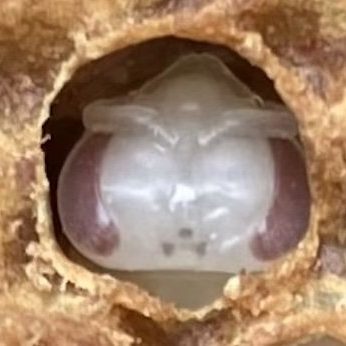
In the picture on the left you can clearly see three partially chewed out pupae in the patch of uncapped cells with pupae at the pink/purple-eyed stage.
Remember that in the melee of the hive with its constant air flows, bees find it hard to pinpoint the exact cell with an infected pupae and tend to uncap a patch of cells until they find the one they’re looking for. In this case they found three next to each other. Unaffected pupae will be recapped so they can complete their development.
Here’s another partially chewed out pupae that I subsequently watched the bees remove from its cell.

My focus now has turned to the colonies that I have requeened over the spring and summer with varroa resistant queen lines.
As I showed last month, these colonies have started to uncap cells and chew out pupae as the new queen’s progeny have become prevalent. The previous slabs of brood are now peppered with uncapped or empty cells.
But mite drop counts remain high at above 10 a day. It is now a case of monitoring for a whole season to see whether the colony can bring them under control. Certainly, by spring I should have a much clearer picture of the way things are headed.
By Steve McGrath
Varroa resistant summary for July:
- Uncapping and chewing out was less evident during the main flow as bees focused on processing nectar but is now picking up again as the flow is over.
- Daily mite drop numbers are fewer than one a day in my best colonies, compared with over 10 a day in previous mite breeding colonies that have now been requeened with queens from varroa resistant queen lines.
- There is likely to be a spike in daily mite drop numbers in all the colonies as the whole colony starts to contract going into winter. This spike, normally seen in August and September, may start early this season.
Every month through the season, we will publish an article detailing what’s going on in varroa resistant apiaries, explaining our observations, to help those who may be starting their varroa resistant journey.
The Wasps Are Winning: A Closer Look at 2025’s Surge in Wasp Activity
This summer has brought a sting in the tail for many UK beekeepers. Reports of unusually high wasp activity have been widespread, with colonies across the country under siege from relentless wasp raids. Weaker hives in particular have suffered significant losses, as wasps take advantage of any vulnerability to rob honey stores and destroy defences. So what’s behind this year's wasp boom—and what can be done?
A Perfect Spring for Predators
The root of this year’s problem likely lies in the unusually warm and settled spring we experienced. These favourable conditions provided the perfect start for wasp colonies. With an early abundance of prey insects and nectar, queen wasps emerging from hibernation in March or April were able to build their nests efficiently and lay eggs in good numbers. This allowed for strong, rapidly growing colonies heading into the summer.
.jpg)

Understanding the Common Wasp (Vespula vulgaris)
The common wasp, Vespula vulgaris, is a familiar sight in gardens and woodlands across the UK. A typical colony begins in spring when a fertilised queen emerges from hibernation and starts building a nest from chewed wood pulp. She lays eggs, and once the first brood of sterile female workers emerges, they take over foraging and nest expansion duties.
Throughout spring and early summer, these worker wasps forage primarily for protein-rich foods like caterpillars and insects, which they feed to developing larvae in the nest. In return, the larvae secrete a sugary liquid that the adults consume—an energy-rich mutual exchange that fuels the workers through the busy season.
However, this harmony doesn’t last forever.
Sugar, Sugar – The Late Summer Frenzy
By late summer, the queen’s egg-laying slows and eventually stops. With no new larvae in the nest, workers are suddenly cut off from their sugary supply. What follows is a frenzied hunt for alternative sugar sources—ripe fruit, fizzy drinks, jam sandwiches... and of course, honey bee hives.
This seasonal shift in behaviour is what brings wasps into direct conflict with beekeepers. Drawn by the scent of honey and the opportunity to plunder unguarded stores, wasps will repeatedly test hive entrances for weaknesses. Once they find a way in, they can decimate smaller or poorly defended colonies. Unlike honey bees, wasps don’t die after stinging and can be ruthless in their assaults, often killing adult bees and carrying off brood.
What Can Beekeepers Do?
Facing such high wasp pressure, prevention and hive management become critical. Here are some practical steps beekeepers have been taking:
- Reduce hive entrances to make it easier for bees to defend.
- Use wasp traps near hives to draw away and eliminate foragers.
- Ensure no spilled feed or honey is left around apiaries—anything sweet will attract wasps.
- Inspect and unite weak colonies early in the season to reduce vulnerability.
- Avoid feeding sugar syrup in daylight, when wasps are most active and likely to smell it.
Even strong colonies can struggle if the pressure is constant. Some beekeepers have had to move hives or erect physical barriers to help protect entrances. There’s no one-size-fits-all solution—but vigilance and proactive steps can make the difference.
A Reminder from Nature
While wasps are often seen as the villains of the late summer, it's worth remembering that they play an important role in the ecosystem. Earlier in the year, they are valuable pest controllers, hunting caterpillars and aphids that might otherwise damage crops and gardens. The trouble comes when nature’s balance is tipped—either by weather, human influence, or both.
As beekeepers, we know that every season brings its own challenges. This year, wasps have reminded us just how quickly circumstances can shift. With careful observation and good hive management, we can limit the damage and keep our colonies thriving into autumn.
By Gareth Trehearn

European Beekeeping Association
The European Beekeeping Association is a new organisation that was formed in February 2024 and already has 55 member organisations in over 30 countries, with a total of over 400,000 beekeepers. BIBBA trustees saw benefits in joining and were the 26th to do so. As is often the case, being a bit like insurance, little notice is taken until there is a need, but already there have been giant strides made on behalf of European beekeepers.
One benefit for ordinary beekeepers is the monthly magazine “NO BEES, NO LIFE”. All back issues can be downloaded in different resolutions, either via the EBA website or from BIBBA website. There is a lot of information, some may not be interest to all, but I found the following topics at random – counterfeit honey, mead, entombed pollen, apitherapy and bee behaviour. Well worth downloading for winter reading.
Roger Patterson

BIBBA Videos
This summer, we have filmed material for several new videos that mainly cover practical beekeeping. When edited, they will be placed on the BIBBA YouTube channel, but probably during the winter months when we are less busy. There will be a mixture of longer and shorter ones to suit a variety of abilities and interests.
BIBBA are gaining a reputation for the topics we cover and the down-to-earth nature of them, where we show things beekeepers need that may not be available elsewhere or suitable for our conditions.
There is a long wish list for future topics, so we won’t stagnate. If you have any requests for topics, please email and we will add to the list if not already there.
The purpose of BIBBA videos is to help beekeepers, so please publicise as widely as you can and ask your local BKA to place a link on their website.
Roger Patterson
BIBBA is encouraging members to raise extra queens and nucs-ideally for local sale-to help reduce the demand for imported stock. Supporting local bees is key to improving resilience, adaptation, and sustainability in our beekeeping.
If you have bees for sale, or are looking to purchase from fellow members, head over to our dedicated page at bibba.com/bees-for-sale to see what's available.
Please note: While BIBBA cannot currently inspect or vouch for queens and nucs listed, all sellers are required to agree to the following statement:
"I confirm that my queens are raised from local stock and are not imports, and that I support the objects of BIBBA."
The primary aim of BIBBA is the conservation, restoration, study, selection, and improvement-for the public benefit-of the native honey bee of Britain and Ireland (Apis mellifera mellifera), as well as near-native and locally adapted honey bees.
Let's work together to strengthen our bees, locally and sustainably.
Call for Volunteers: Video Editing
Do you have basic video editing skills, or an interest in video editing, and can spare a little time to help BIBBA optimize its videos? We are looking for volunteer members who might be able to do some basic video editing, including time stamping, cutting, and adding cards and stills.
Our videos get thousands or even tens of thousands of views each and are a key part of our mission to help educate beekeepers of all levels, but we need some extra help to ensure that they are as impactful and reach as wide an audience as possible. If you have the skills already then you'll be ready to go, but if you have an interest then training can be provided! Please let us know if you are interested at .

BIBBA supports the banning of honey bees imports.
At a recent BIBBA trustees meeting it was agreed to support a ban on honey bee importation as policy. This is in response to the known threat of tropilaelaps being introduced to our shores via bees from Europe. Although BIBBA has previously not supported an outright ban for some time, this increasing threat leads us to adopt a stronger position for the good of the craft, the bees and our members.
The opinions expressed in articles in BM are those of the authors and do not necessarily reflect those of the BIBBA Board. While the editorial team considers all material received carefully before publishing, it does not disbar those who may have a perfectly good argument.