After Varroa arrived in the early 1990s, a Varroa calculator was developed to estimate colony risk based on infestation levels and to suggest appropriate actions.
Prof Stephen Martin, one of the original developers, has now created a much simpler, faster, free, web-based calculator that estimates mite populations and recommends what to do at different times of year.
Why does the mite threshold matter?
The threshold is the mite population above which serious colony damage — including collapse — becomes likely. Its value could only be estimated once the role of DWV was understood, and it varies through the year. In summer, a colony generally tolerates up to around 12,500 mites before collapsing, because worker production is high and adult lifespan is short. In autumn, when brood levels fall, the threshold drops sharply to about 2,500 mites. Colonies in subtropical or tropical regions can withstand higher mite loads because they rear brood continuously. Go to the new Mite Calculator
Here in the southeast of England, we’ve had a wet start to winter, but also a very mild one. There have been a few frosts, but in the second week of December I visited a couple of apiaries to do winter checks and I was left in no doubt that all the colonies were still alive because they were all flying in about 14 degrees Celsius. They’re all still hefting heavy, so I’m also not worried about stores as yet.
If you’re new to hefting, then Roger Patterson describes how he does it on a recent video we have added to the BIBBA YouTube channel. Please do subscribe to the channel as we’ll be adding new videos throughout the winter so you can take some new tips and tricks into the new season.
We have already added a number of videos on the impending threat of Tropilaelaps, which brings with it fate worse than varroa. In videos part funded by BIBBA, the team at PHIRA Science explain the lifecycle and symptoms of the mite and how to spot them in your colonies, while Roger Patterson caught up with a bee farmer in Georgia who told him how the spread of the mite is hammering commercial and hobbyist beekeeping in the country.
It’s just one reason why BIBBA supports a ban on bee and queen imports into the UK. You can find out all the reasons why BIBBA supports a ban here, including the potential adverse impact on the work being done to raise local varroa resistant bees.
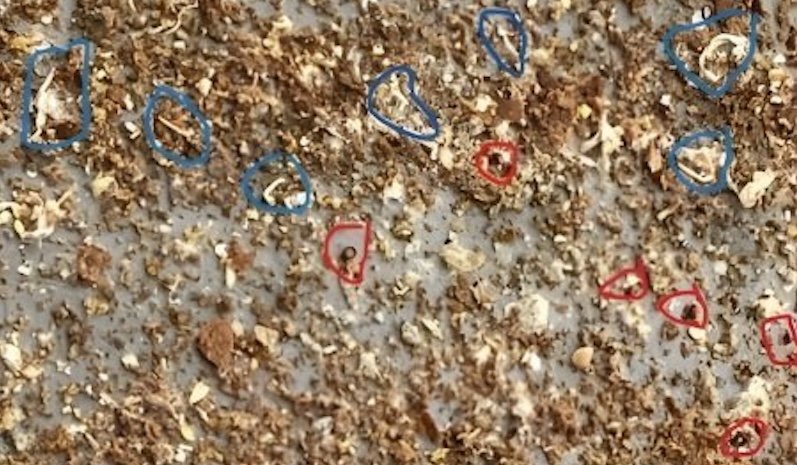
In my varroa resistant apiaries, my winter checks at the hive start with varroa. I take out the insert board or tray and inspect it and take a photo of each one for a more detailed analysis and mite count when I get home and can blow it up on my phone and record the results in the warm. (The bottom boards also confirmed my flying bees weren't robbing each other).
After cleaning the board or tray off, I will then heft, and where I have a see-through crown board I might be tempted to peek under the insulation if it’s not too cold. In some colonies you can see the cluster pancaked across the Perspex crown board, while in others the cluster remains down in the brood chamber. I check entrances to make sure they’re clear, and occasionally you’ll see evidence of varroa resistance here too, with pupal parts removed via the entrance after being chewed out of varroa infested worker brood cells.
 Steve McGrath
If you leave it too long between winter checks, then a build up of debris can make It difficult to do an effective mite count by sight alone, even when blown up on your phone or computer. In this case, I scrape the bottom board debris into a corner and then into a container – a sealable freezer or food bag works well. When home, I take the debris out and either sift through it (a pair of tweezers works well to move debris around and sort pieces) or soak it in methylated spirits In a container, give it a shake and let it settle. Most of the debris stays at the bottom, while the mites and some light debris floats, enabling a more accurate count.
 Steve McGrath
I’m looking for individual colonies to end December with a mite drop count no higher, and preferably lower, than where they started back in January. So far, this seems to be the case across my colonies.
I’m also busy pulling together the mite drop data for the whole year, and it’s looking very positive, with my best hives so far showing a daily average mite drop of fewer than one a day for the year as a whole. That will be my best year in terms of mite drop. This continual decline in mite drops over seasons in varroa resistant colonies has been observed by other varroa resistant beekeepers.
In any varroa resistant colony which is uncapping cells and chewing out infected pupae, I would like a maximum average daily drop of fewer than five for the whole year. Any higher than this and I will be looking to re-queen the colony next season.
The full data set will influence my breeding program for 2026, raising queens from the best third, re-queening the worst third and monitoring the third in the middle.
The data sets from the colonies that weren’t varroa resistant and were re-queened with a queen from a varroa resistant queen line will be very interesting and I will share a case study on them in BIBBA Monthly next year.
For anyone transitioning to varroa resistance, this can be a nervous time of year as the winter treatment could be the first one you skip as part of the transition. It’s advisable to make sure you have clearly seen signs of both uncapping and chewing out of infected pupae in the colony over the summer and that you’re monitoring mite drops. Remember, uncapping alone is not enough, you need to see evidence of chewing out. With your insert board in, you’ll be able to continue counting mite drops and record evidence of chewing out throughout the winter. Spring will better reveal how your bees are coping without that treatment.
Varroa resistant summary for December:
- Insert boards and trays are now the beekeeper’s essential tool for monitoring varroa resistance over winter. You’ll be able to do average daily mite drop counts throughout the cold period, while pupal parts will evidence chewing out during periods where there is brood.
- The aim is to end the year with a daily mite drop at least the same as, and preferably below, where the colony started the year.
- At the end of December, you can calculate the average daily mite drop for the year as a whole. A number of five or fewer, combined with evidence of uncapping of brood cells and chewing out of infected pupae recorded during the year, shows strong varroa resistance.
- Winter jobs include continuing to record your average daily mite drop and observations of pupal exoskeletons every time you go to check and heft hives. Try and do this regularly so that debris doesn’t build up too much. Otherwise you’ll have to sift the debris to do an effective mite drop count.
- If you’re transitioning to varroa resistance, the winter treatment could be the first one you skip. It’s advisable to make sure you’ve evidenced the key traits of varroa resistance – uncapping and chewing out of infected pupae – before you take that risk.
Videos for Beginners
Many of those who enter, or are thinking of entering the craft, are flummoxed by the amount of information (and misinformation) available, much of it conflicting. In some instances, there is a lack of information, usually leading to similar questions being asked of several people and we all know the number of answers that results in. This topic comes up regularly, recently by a BIBBA trustee recounting when they started beekeeping.
This has given us the idea of providing short videos to give guidance on points that beginners want to know, but have difficulty in finding the answer. We were all beginners once and we all have memories of being in the same position, so I ask members to email those questions and any they have been asked by other beekeepers. Please help us to help others by emailing to
BIBBA Teaching Toolkit
Since the notice in the September issue of BM, we have been asked about progress of the Teaching Toolkit. As stated, it will take some time to get to the stage where it can be used. The basic framework is currently being assembled, with some elements being populated. We aren’t using the “standard” material that is often taught, but a mixture of good, reliable information that is currently available, but not perhaps well-known, together with some that is written for the purpose. There is a mixture of practical and scientific material that is in the public domain, together with help and guidance for those involved in teaching that will only be available to registrants.
Roger Patterson

“HOMEMADE” MASS SELECTION OF BEES
AN IMPERATIVE FOR SUSTAINABLE BEEKEEPING
Many queen bee breeders, over time, in pursuit of profit, became queen bee "producers". It is high time we, as beekeepers, take control of the selection process.
Read this article in issue 18 of the European Beekeeping Association magazine on improving your bees
note: the last sentence of page 41 "To preserve the purity of our race, it is necessary to import and buy queens annually"
should read "To preserve the purity of the imported race , it would be necessary to import and buy queens annually"
CaSCA Events 2026
From hobby to business;
 grow your beekeeping, grow your income
A one-day course for beekeepers who sell their hive products.
A different approach with more efficient and suitable management methods
Speaking to Children About Bees

Tuesday 13th January at 7:30pm GMT
This talk is for anyone who is interested in teaching children about bees and beekeeping, describing tried and tested methods of engaging children about bees and how to adapt teaching to different age groups.
Why CHC Differences Matter for Beekeepers
The study shows that different subspecies of Apis mellifera carry genetically-determined variation in their cuticular hydrocarbon (CHC) profiles. These hydrocarbons — the waxy coating on a bee’s body — are vital for preventing desiccation and also act as chemical cues for nestmate recognition and potentially communication within the colony.
By raising six subspecies under identical “common-garden” conditions, the researchers demonstrated that CHC differences persist even when environment is controlled. This implies a genuine genetic basis for CHC variation rather than an environmental or hive-based effect.
What This Study Implies for Beekeepers & Bee Improvement
◆ Preserving Genetic Identity
For beekeepers aiming to maintain or restore local, native, or historically authentic bee types, distinct CHC profiles suggest a potential biochemical marker of subspecies identity. If practical in future, CHC monitoring could complement morphological and behavioural checks for colony purity.
◆ Queen-Raising & Nuc Production
Because CHC signatures remain stable across environments, selecting for a subspecies is likely to bring these chemical traits with it. This may influence:
- ► colony cohesion
- ► nestmate recognition
- ► queen acceptance dynamics
All of these behaviours matter when raising queens or uniting colonies, especially where stock from different origins is involved.
◆ Behaviour, Drift & Colony Stability
Variation in CHCs may influence how mixed colonies interact, how they tolerate non-nestmates, and how vulnerable they are to drifting or robbing. This offers clues about why some cross-subspecies combinations perform poorly or exhibit reduced colony harmony.
◆ Future Scientific Tools
While CHC profiling requires specialist equipment (GC-MS) and is not practical for everyday beekeepers, it opens the possibility that future breeding programmes could incorporate chemical phenotype as an additional marker for subspecies integrity.
What the Study Does Not Show — What to Watch
The authors did not find strong evidence that CHC differences represent adaptations to climate. Interestingly, the difference between nurse bees and foragers from the same colony was greater than the differences between subspecies — emphasising that CHC profile is shaped dramatically by worker role and age.
- ► CHCs are not a clear indicator of climate adaptation among European subspecies.
- ► Mixed-age or mixed-role samples would make CHC interpretation unreliable.
Study Conclusion
CHC variation represents a potentially important — if currently impractical — layer of bee genetics. It broadens our understanding of subspecies differences and highlights the value of subspecies-conscious breeding, even if CHC analysis is not yet a field tool for beekeepers.
Having reviewed the study closely, the BIBBA Scientific & Technical Team holds significant reservations about its usefulness, scale, and applicability to practical beekeeping.
- ► “The data seems to be originally collected in 2018 but only recently analysed (or perhaps over-analysed) in an attempt to find something publishable.”
- ► “We cannot say that forager age is the decisive factor because the authors did not put foragers back into a sealed hive to determine whether they revert to a nurse-like CHC profile.”
- ► “The very small scale of the study limits its power to yield meaningful insight.”
- ► “Only five foragers and five nurses were tested per colony, and only two colonies per subspecies. Given that each queen mates with many drones, this is nowhere near enough to characterise an entire subspecies.”
The team concludes that while scientific studies can offer new perspectives, beekeepers must interpret them with care. A specialist paper may present findings that appear interesting in isolation, but these may not translate into meaningful guidance for practical colony management.
Deciphering the variation in cuticular hydrocarbon profiles of six European honey bee subspecies
Rodríguez-León et al. BMC Ecology and Evolution (2024) 24:131
https://doi.org/10.1186/s12862-024-02325-z