 Klaas de Gelder

CaSCA is a new initiative from BIBBA that is intended to help beekeepers who sell hive products through at least one regular outlet, which could be anything from the home or workplace, to a network of outlets. Once colony numbers are increased, there becomes a need to increase efficiency, reduce costs and adopt colony management methods that are more advanced than the ordinary beekeeper is taught.
Saturday January 24th Barwick Village Hall
Chapel Ln, Barwick in Elmet, Leeds LS15 4EL
Sunday January 25th Frodsham Community Centre
Fluin Ln, Frodsham WA6 7QN
Saturday February 7th Lenham Community Centre
12 Groom Way, Lenham, Maidstone ME17 2QT
Sunday February 8th Pulborough Village Hall
Swan View, Pulborough RH20 2BF
Saturday March 14th Risby Village Hall
Aylmer Cl, Risby, Bury Saint Edmunds IP28 6RT
Sunday March 15th Lubenham Village Hall
1 Laughton Rd, Lubenham, Market Harborough LE16 9TE
After such a mild autumn, it has almost been a shock to experience the recent cold snap. A quick peek through the Perspex crown board on a couple of hives shows the bees clustered underneath, sustained by the stores left on the hives for them to overwinter on. For me, the cold snap is no bad thing, helping to re-set nature and naturally thin out the number of potential pests for my colonies next year.
Most hives are still hefting heavy, so I’m not worried about stores for the most part although some beekeepers are reporting a lot of crystallized ivy honey in frames and indeed the tell-tale signs of chewed out white crystallized stores are evident on some insert boards and trays. I’ll keep a close eye on those.
In my varroa resistant apiaries, the insert boards I leave in all year are telling me a lot about what’s going on inside. As soon as I slide the board out, I can tell whether the bees are still alive and where the cluster is sitting. Taking a picture of the board before clearing it off allows me to take a deeper look by zooming in when I get into the warm at home.
There I can do my regular daily mite drop count, and I can also see signs that the queen has re-started laying now the days are getting longer with single eggs appearing on the tray. That means it won’t be long before I expect to start seeing the colony’s varroa control kick back in, with pupal remains appearing on the trays as they chew out infected pupae.
At this point it’s worth reminding ourselves of the definition and key traits of varroa resistance:
“Honey bees that manage their own varroa populations, without any involvement by the beekeeper, to a level that allows the colony to function normally without any significant loss of bees or honey.”
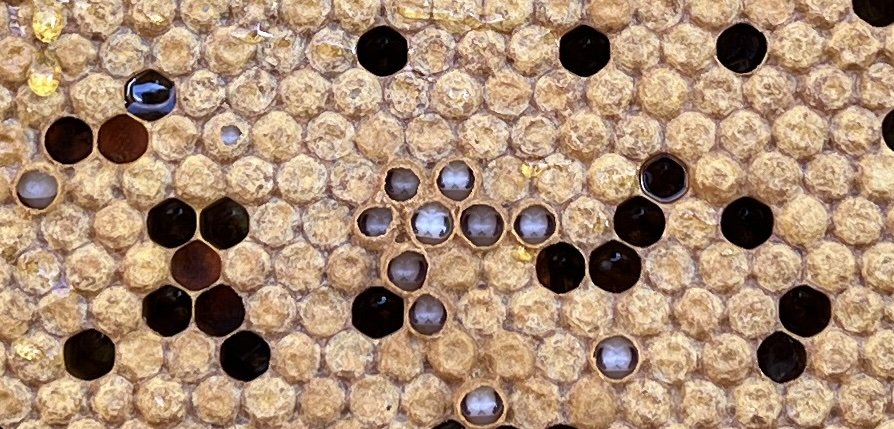
These bees manage their varroa populations by detecting infected capped brood at the pink/purple-eyed stage of pupal development, uncapping it and chewing out the infected pupae. This disrupts the breeding cycles of the mites, keeping the population at a low level.
For a beekeeper, that means the traits are evident when you see brood uncapped at the pink/purple-eyed stage and pupal remains resulting from the chewing out either in cells or on the varroa insert tray. These observations should be recorded alongside a consistent and regular mite count to ensure the mite population remains low on a seasonal basis.
I now have my daily mite drop data for my colonies for the whole of 2025. What I’m looking for is an average daily mite drop for the whole year of five or fewer, and for the number at the end of the year to be at or below where it was in the first count of the year.


For my best colonies, the number is well below the five-a-day average, and they’re ending the year dropping about 0.4 to 0.7 mites a day, lower than they were at the start of the year. Some of my colonies were dropping fewer than one a day for the majority of the season, and in one particular apiary this was across all the colonies. The seasonal spike in mite drop you typically see in the autumn as the brood nest contracts was also far less pronounced in these colonies.
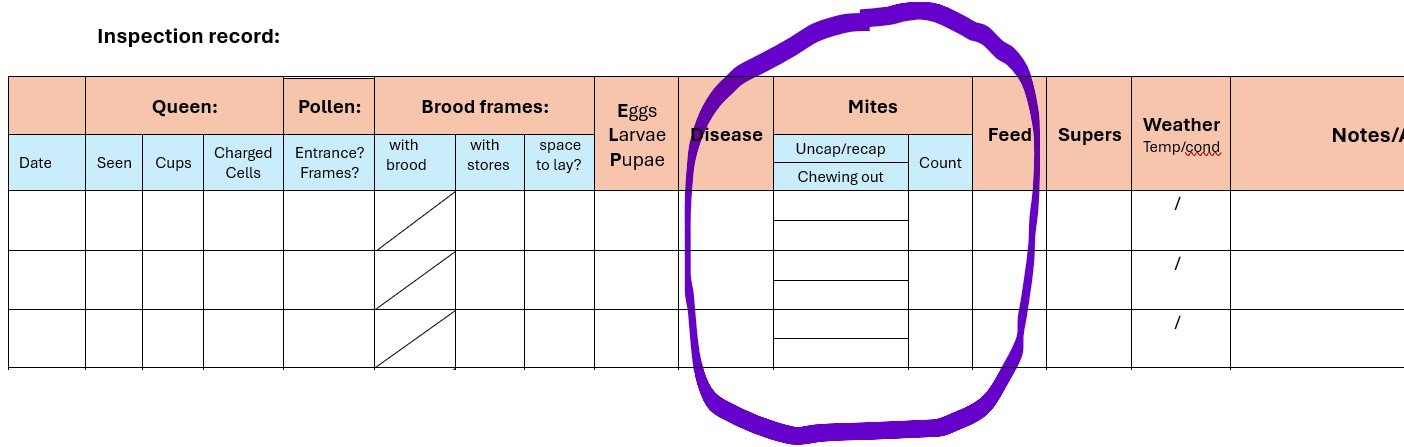
That means I can now plan for 2026. This year I have fewer colonies that need re-queening due to the colonies being mite susceptible (ie not able to survive without my intervention), but I will re-queen those remaining and some of the weaker mite resistant hives with queens from my best performers, as well as producing excess queens for colony expansion or sale.
For any beekeeper hoping to transition to varroa resistance in 2026, January is an ideal time to start. Hopefully you’ll have spotted the traits in some of your colonies last season and know which colonies are candidates. For those, update your hive record card so you can keep track of performance, start counting mite drops if you’re using the varroa insert tray method, and start planning the year ahead.
Some considerations are:
- Whether you will separate the transitional colonies into a separate apiary, or at least a separate area of your apiary, so they’re not continually re-infected from neighbouring mite susceptible hives.
- Which mite count method you will use? The varroa insert tray is the one I favour because you get an indication of the population across the whole colony throughout the year. Whichever you choose, be consistent and check regularly. The mite population calculator at https://www.varroaresistant.uk/mite-calculator/ allows for different monitoring methods.
- How will you reduce your treatments? If you’re treating twice, will you initially drop to one and perhaps skip the treatment next winter if mite count numbers support that? If you’re treating just once already, will you move to every other year with enhanced monitoring?
- Will you try some biotechnical interventions like queen trapping or drone brood removal to give your bees more time to develop their resistance and give yourself more confidence?
- The key to transition is to reduce intervention and increase monitoring, but to give it time. Be prepared to step in if the mite levels require it.
You’ll find more resources to help with your transition to varroa resistant beekeeping on our website at https://bibba.com/varroa-resistance/.
There are sections there on identifying varroa resistant bees, starting on your varroa resistant journey, and breeding varroa resistant bees and you can also sign up for an email journey with useful guidance, support and tips.
Each month for the past year we have published an article detailing what’s going on in varroa resistant apiaries, explaining our observations, to help those who may be starting their varroa resistant journey. The first article was published in the February edition of BIBBA Monthly.
Varroa resistant summary for January:
- Keep checking Insert boards and trays each time you visit your hives for a winter check and heft, counting the mite drop and recording any other observations.
- As the queen starts laying again, a varroa resistant colony will start managing their varroa population in the brood nest and so pupal remains can start to appear on insert boards as early as this month as they chew out infected pupae.
- January is the month to start planning: if you already have varroa resistant colonies, which ones will you breed from, and are there others you will re-queen from the best performers? If you don’t have colonies showing the traits, can you acquire some from another local beekeeper? Many associations now have beekeepers with varroa resistant bees.
- If you’re planning to start your transition to a varroa resistant apiary this year, have you identified colonies where you saw the key traits last year and formulated a plan for reducing treatments? Have you thought about keeping your VR colonies in a separate apiary and which monitoring method you will use?
Working Together
This article is an example of how BKAs and beekeepers can work together to improve the honey bees in their area. The two BKAs featured are Wisborough Green (Roger Patterson) and Eastbourne (Simon Tuck) that are both in Sussex, about 40 miles direct distance apart, with similar conditions.
Being in the south, the bees kept by many beekeepers can loosely be described as “yellowish, prolific mongrels, mainly derived from imports”. Apart from a few BKAs, many don’t teach about locally adapted bees or queen rearing, leaving their members to buy queens online. There are also a considerable number of bee farmers who use “Buckfast” that are also mainly exotic genetically. All of these influence local bee populations, often leading to high colony losses and defensive behaviour in the future generations.
Below, Roger and Simon describe how only a small amount of effort and co-operation is needed to make real progress.
 From the Wisborough Green BKA (WGBKA) end - Roger Patterson
I started beekeeping in 1963 and have seen the results of continued importation in managed colonies, with several bursts of importation that followed various events including the hard winter of 1962/63, the self-sufficiency boom, the introduction of varroa and the rapid influx of beekeepers in the early years of c21st, resulting in large queen importations. The exotic types largely disappeared within a few years when imports reduced and nature took out those it didn’t like. Imports are visually quite distinctive and it’s easy to see if a colony has exotic influence.
I have been involved with several hundred free-living colonies that are free from human intervention and subject to natural selection, that is ruthless. If something is weak in whatever way, it’s not part of future generations. In seeing these colonies, they taught me about local adaptability and on many occasions I have stated that in my experience if a free-living colony has survived one winter, they show little indication of possessing exotic genes. That has taught me the sort of bees that are likely to best survive in our fickle climate, so that is what I select for when choosing colonies to raise queens from.
I haven’t bought a queen for 60 years, always raising from my own, or occasionally if another beekeeper has good local stock in a similar conditions to me, having a queen or queen cell. I have my own colonies, but have been involved with the WGBKA teaching apiary for many years, for the last 20+ being the apiary manager. I have always shared genetic material with my own and WGBKA apiaries. At the teaching apiary we have bees that visitors often consider are well behaved compared to their own. They are also productive, with very low winter losses. We usually have 20-30 full colonies for teaching and 25-30 nucs for queen rearing. The bees can be seen regularly on Live@theHive.
Through BIBBA, ln 2021, Simon Tuck of Eastbourne BKA asked to purchase a queen from us. Following several emails, Simon attended a meeting and took some larvae for grafting. This was repeated several times, with Simon selecting the colonies and doing his own grafting. Simon will describe what he did and how he did it, but although I have never had our bees DNA tested, unbeknown to me, Simon had some from one of our colonies (Yaffle) tested and I was very surprised to find they were about 65% M lineage, showing that even in a heavily mongrelised area, the background genetics can still be favourable. Yaffle happened to be a colony that showed uncapping characteristics in 2025, so we hope will be varroa resistant. A colony in my home apiary that is headed by a daughter queen from Yaffle is featured in a short video that is a clip from a Live@theHive broadcast where I unexpectedly saw uncapping when we were live.
At WGBKA and my home apiary, in most years, we raise 100-150 queens in several ways and have them mated in standard frame nucs or in my own design of mininuc, where queens can be over-wintered. Because of several beefarmers and non-members operating in our area using imported queens, we find that our queens sometimes mate with undesirable drones, so we have to cull a few queens, but that’s part of the selection process, effectively taking out what natural selection would. Good queens are distributed to members and used to replace poorer queens in the main apiary. This year, we hope to extend the programme to invite local BKAs, in the hope they can follow Simon’s example.
 Simon Tuck
From the Eastbourne BKA (EBKA) end - Simon Tuck
I’ve been keeping bees for only a fraction of the time Roger has, but from the outset one thing felt obvious:
If you want resilient bees, it makes sense to work with bees that do well here.
Bees shaped by our seasons, our forage, and our local disease pressures.
But there’s a catch… where do you get them?
Like many people, I started by ordering “local blacks” from a supplier. They arrived — and they clearly weren’t. That early disappointment is what eventually drew me towards BIBBA: shared intentions and a practical alternative to the endless cycle of importation.
It also didn’t take long to realise that Roger Patterson was about as “local” as one could hope for — and crucially, he was willing to share. Much has been gained through Roger’s generosity and passion for offering an alternative path. He invited me over to see what he was doing and even gave me a queen he’d raised.
Learning by doing (and making mistakes)
Over the next couple of years, I took genetic material from Roger’s apiary and started grafting myself. For me, the most reliable method was taking a full frame of eggs and young larvae from a desirable colony, then grafting over the following days.
A practical challenge was transport — I live about an hour away — so I built a simple 12v incubator using instructions from The Apiarist (excellent resource). It let me keep the frame at the right temperature and humidity during the drive home and meant I could graft for 3–4 days from the same frame while larvae were still of the right age.
I also experimented with setting up a small nuc of loose bees and at Roger’s apiary placing a grafted frame into it (bumping the bees to reduce flying and spraying with water so I could swap frames in and out). That method had a lower success rate, but it did allow me to raise queens from more than one colony — essential to avoid bottlenecking genetic lines.
By 2025, I had a small mating apiary full of “sister” queens from 2024. The idea was that drones from those queens would mate with my 2025 grafted queens — some influence over mating, even though we all know queens generally fly further than drones and complete control is almost impossible in the southeast.
Was it perfect? No. Did it work better than I expected? Actually, it did.
 Simon Tuck
 Simon Tuck
2025: A big year for queen rearing
In 2025 I produced over 40 queens from a colony called Yaffle, which showed clear signs of hygienic behaviour, and 9 from Throstle, another desirable colony.
My Apideas didn’t perform as well as in previous years and I had a higher failure rate than expected, which meant I couldn’t distribute as many mated queens to members as I’d hoped. But even that “failure” was useful: it pushed me to improve the method and consider options for better mating control.
Which brings me to something I never imagined I’d be doing…
I trained in instrumental insemination, learning from Susan Cobey in the US. I’m still early in using it properly within a full season, but it gives me another tool to support long-term plans — where controlled mating matters.
As of now, I have seven Yaffle daughter queens overwintering in poly nucs in my garden apiary, with my bee pal overwintering another. I also still have three Throstle queens, which I plan to use as drone producers for 2026. (Drones carry only the queen’s genetics, so a queen from a desirable mother can still be used as a drone-producer even if her mating was mixed. There’s a lot of power in that when you’re starting out with breeding.)
The colony I’m most pleased with is a Yaffle line that was instrumentally inseminated with drones including those from Starling daughters (from 2024). They’re showing the sort of calm, workable temperament I recognise in the Wisborough Green “stingless” bees — as close as I could realistically hope for.
And all eight Yaffle daughter queens have shown clear hygienic behaviour this season.

The test: how “native” are they?
The conservationist in me wants to work with a sustainable reworking of our native subspecies, so I was keen to find out how native Yaffle’s daughters really were.
They passed visual checks, and I also carried out a simple wing morphometry test using the right forewing of 30 workers — again, encouraging. I figured it was worth paying for a genetic test.
Beebytes is widely known for offering a straightforward DNA test that identifies how much influence there is from the ‘C’ lineage subspecies — broadly those descended from east and south of the Alps. The kit arrives by post. You collect 15 drone pupae using aseptic technique, remove one hind leg from each into a buffer solution, send it back — and later receive a PDF report.
I chose to sample from one colony because I still have other genetics in my apiaries and I didn’t want a blurred picture, but you can potentially sample drones from more than one queen.
The result came back at 65.2% M lineage.
My “local blacks” — finally achieved after all those years!
Future plans (and an invitation)
This result was exciting for me — and even more exciting to learn it was exciting for Roger too. I always assumed he already knew his bees were near native after 60 years of rigorous selection. But having it confirmed in print matters, and it helps strengthen the case for locally adapted breeding programmes.
Breeding is never static (queen lifespans make sure of that), so my plans now are to scale up, increase sustainability, and encourage others to do the same — on whatever scale fits their beekeeping.
I’m also looking forward to collaborating with the B4 Project in Cornwall, which has strong evidence of Varroa resistance and an even higher proportion of M lineage.
And yes — I’ll be continuing to work with Roger as we aim towards a sustainable population in the South, where resistance to varroa is a real possibility.
Getting members involved
What we’re doing in Eastbourne and Sussex isn’t unique — and that’s the point. This can be done anywhere. What helped give my work real momentum locally was setting up a small BIBBA group — the Sussex Coast Honeybee Improvement Partnership (SCHIP) — to give the breeding programme an identity and a shared purpose. I’ve run queen rearing training so that interested members can get up to speed with selection, grafting, queen rearing, and testing. To quote my bee pal in relation to grafting, for example:
“I struggle to use chopsticks, so if I can do it…”
Reliable queen introduction is just as important if others are to benefit from potentially valuable breeders.
There’s a lot to learn, new skills to develop, and plenty of people to involve. I’m still only just past the start line — but it’s exciting.
Summary
There are so many benefits to working with locally adapted and/or near native honey bees. One of the simplest is reducing risk: every imported queen is another opportunity for Tropilaelaps or Small hive beetle to hitch a ride to the UK.
But the bigger point is this: there are lots of us working hard to build a better future for UK beekeepers — one that’s sustainable, practical, and rooted in local bees.
So, join us.
Get involved with BIBBA. Share ideas, learn together,
and help build a honey bee population ready for whatever challenges lie ahead.
Personal thanks go to Roger Patterson, Rhona Toft, Susan Cobey and the Wootton Manor estate, who have all been exceptional in encouraging and supporting my bee breeding programme.
contact Simon Tuck
 Klaas de Gelder
The Hidden Cost Inside the Hive
Hidden DWV infections can wreck a colony long before any deformed wings appear. This article explains how “invisible” DWV quietly drains nectar, shortens worker lives and undermines winter survival—and why breeding for viral resistance must join Varroa control in every beekeeper’s toolkit.
by the Scientific & Technical Working Group: Karl Colyer and Paul Verrier
Why viral resistance needs to be part of the beekeeping conversation
Most beekeepers associate Deformed Wing Virus (DWV) with the obvious: crippled wings, crawling bees, and colonies that fail to make it through winter. But new research shows that even when no deformed wings are visible, DWV can quietly undermine a colony from within.
A recent study published in Scientific Reports (Ferreira et al., 2025) reveals how DWV affects the foraging behaviour of adult worker bees, with consequences that ripple through colony nutrition, resilience, and survival. The findings strengthen the argument that DWV resistance — not just Varroa control — must become a core part of sustainable beekeeping.
Not just a winter virus
DWV is now almost ubiquitous wherever Varroa destructor is present. While high virus levels cause the classic wing deformities, many infections are “covert”: bees look normal, fly normally, and continue working.
For years, these covert infections were assumed to be relatively harmless. This new study challenges that assumption.
The researchers experimentally infected newly emerged workers with DWV (without causing visible deformities) and compared them to protected control bees in full-sized colonies. They then followed these bees through their working lives, carefully recording when they started foraging, what they collected, how successful they were, and how long they lived.
What they found should concern every beekeeper.
DWV pushes bees to forage too early
Healthy worker bees normally spend the first part of their adult lives inside the hive, nursing brood and maintaining the colony, before transitioning to foraging later on. This balance is essential for colony stability.
DWV-infected bees, however, began foraging earlier than normal — a phenomenon known as precocious foraging. This is not a benefit to the colony. Early foragers are:
- Less efficient
- More likely to die
- Replacing nurse bees before they should
The study showed that DWV-infected foragers also had shorter foraging lifespans, meaning they died sooner once they started flying. Over time, this drains the colony of both nurses and effective foragers.
In practical terms, DWV accelerates workforce burnout.
Nectar collection suffers — badly
Perhaps the most striking finding concerns nectar. Compared to healthy bees, DWV-infected nectar foragers:
- Returned less often with nectar
- Collected nectar with almost half the sugar concentration
On average, infected bees brought back nectar at around 13 % sugar, compared with 21 % for controls.
This matters enormously. Nectar sugar concentration determines:
- Energy return per foraging trip
- Honey yield
- Ability to build winter stores
In late summer and autumn — exactly when colonies need to build reserves — low-sugar nectar means more flights, more energy spent, and less stored food.
Even if the colony looks busy, it may be quietly running a carbohydrate deficit.
A shift towards pollen — but not a solution
Interestingly, DWV-infected bees were more likely to collect pollen than nectar, and they collected normal-sized pollen loads.
At first glance, this might sound positive. But pollen cannot replace nectar:
- Nectar (and honey) fuels flight, thermoregulation, wax production, and winter survival
- Pollen supports brood rearing but cannot compensate for lost energy intake
The researchers suggest that DWV affects the bees’ nervous system, altering how they respond to sugar and possibly impairing memory and navigation. Infected bees appear more willing to accept poor nectar sources or abandon nectar for pollen altogether.
This creates a nutritional imbalance: protein without enough energy.
Practical take‑aways for bee management by BIBBA Members
- Control Varroa hard and early. Varroa is the main driver that turns low‑level DWV into serious infections; good Varroa control remains the single most effective DWV management tool.
- Watch for subtle performance changes, not just deformed wings. Colonies that are light despite forage, need repeated feed, or show poor foraging activity compared with neighbours may be suffering from DWV‑related foraging impairment.
- Support nutrition. Ensure access to good nectar and pollen sources, and don’t hesitate to feed when natural forage is poor, because DWV‑affected foragers will be less able to “make up the difference” for themselves.
- Breed and select for resilience where possible. Lines that show better Varroa tolerance, stronger overwintering and good spring build‑up are probably coping better with DWV pressure and its hidden foraging costs.
Looking forward
As pressure on forage increases and climate variability grows, colonies cannot afford to lose efficiency. Subtle losses add up. The message from this study is clear: DWV resistance matters, even when wings look perfect.
For beekeepers committed to sustainable, low-input systems, the future likely lies not in fighting symptoms, but in breeding bees that can live with the virus - and still do their job well.
Notes from the Scientific & Technical Team….
- The title seems to imply that the authors are studying Apis melifera ligustica (Italian honeybees and the most commonly kept species in the USA according to Wikipedia). But bees they term ‘Russian’ (but bred in the US) are unspecified in terms of their subspecies. Are they comparing like with like and could the differences identified actually just be a result of their genetic backgrounds?
- It sounds as if the apiaries used were enormous. The methods section describes n=299 Russian colonies across just 2 apiaries. As such, with so many bees in one geographic area, maybe it’s not surprising that there is little forage to be had when ‘overwintered outside’ bees do fly - making each flight a ‘net cost’ to the colony. As such, when UK-based bees fly they might have a better chance of them finding enough forage to make it worth their while (both nectar but possibly more importantly pollen for early brood rearing). As such caution might be advised when applying these results to UK practice. Urban bees tend to have a greater variety of plants available to them locally.
- The study seems to compare cold storage in North Dakota against shipping to and from an overwintering apiary in Mississippi. How much did transporting colonies contribute to the results? They consider the transport impact in terms of costs but not in terms of bee welfare.
Why this matters for colony survival
The cumulative effect of these changes is profound:
- Earlier foraging
- Shorter worker lifespan
- Reduced nectar intake
- Lower honey production
- Increased vulnerability during nectar dearths
A colony may survive the summer yet fail in autumn or winter, not because of starvation alone, but because DWV has quietly eroded its efficiency months earlier.
This helps explain why colonies with “manageable” Varroa levels can still collapse — especially under poor forage conditions or high colony density.
The case for viral resistance selection
Current management focuses heavily on mite control, and rightly so. But this study reinforces an uncomfortable truth:
Even low-level DWV infections cause real harm.
Chemical control can reduce mites, but it does not eliminate DWV. Resistant stocks, however, can reduce viral replication, limit behavioural disruption, and improve long-term resilience.
Traits already discussed within BIBBA circles, such as:
- Varroa Sensitive Hygiene (VSH)
- Suppressed mite reproduction
- Survivorship without treatment
are also likely to reduce viral load and its behavioural impacts.
Selecting queens and colonies that cope better with DWV, not just mites, may be essential if we want bees that can forage efficiently in real-world conditions.
What can beekeepers take from this?
This research does not demand immediate changes, but it strengthens several practical conclusions:
- A colony can appear strong while being nutritionally compromised
- Good Varroa control is necessary but not sufficient
- Supplemental feeding may mask, but not solve, underlying inefficiency
- Long-term solutions must include genetic resilience
Above all, it reminds us that DWV is not just a visible disease - it is a behaviour-altering virus that reshapes how colonies function.