CONTENTS
- Enhanced Direct Debit Discount
- How to Mark a Queen Bee for Better Visibility
- Emergency Cells- a Simple Experiment
- Live@theHive in March
- BIBBA Groups Update
- Wild honey bees on English landed estates

Nick Mawby
BIBBA Chair
Membership & Website
Some good news! We’ve enhanced the Direct Debit discount, so members who pay this way will enjoy an even lower subscription rate.
Thanks to moving our newsletter online, holding committee meetings virtually, and simplifying our operations, we’ve reduced running costs. Direct Debit also makes administration easier for trustees, helping BIBBA continue to run efficiently and entirely without paid staff.
The trustees wanted these savings to be passed back to members. This increased discount will be trialled for one year and reviewed annually to ensure it works well for both members and the organisation.
Other payment options will, of course, remain available for those who prefer them.
Thank you for supporting BIBBA and helping us keep the organisation sustainable, efficient, and member-focused.
Please join us for the AGM on Monday 23rd March at 7:00pm via Zoom: Register Here
HOW TO MARK A QUEEN BEE FOR BETTER VISIBILITY
A non‑invasive queen‑marking study compared thorax, abdomen and wing marking over five months. Abdomen marks provided the largest coloured area and best overall visibility, making queens easier to spot than with thorax or wing marking alone. No adverse effects on queen acceptance, supersedure or survival were observed, provided paint was kept away from the head and abdominal sides (to avoid blocking spiracles). Combining abdominal with thoracic marking is recommended; wing marks fade more quickly and need repeating during the season.
Read the full article in EBA Magazine No 21
 eba
eba
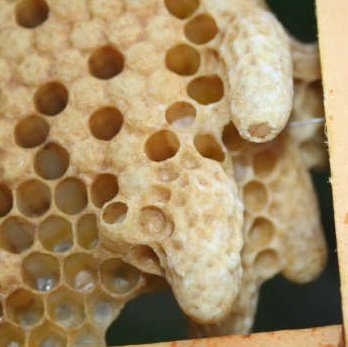
Emergency Cells: A simple experiment that suggests common thinking may be flawed
By Roger Patterson
 To help with learning and understanding I encourage beekeepers to do simple experiments. These, if done in a reasonably controlled way often reveal that bees don't always do what is in books or taught as "fact". We hear the well-worn phrase that "Bees don't read the books", but that may be because the books aren't always written by people who are writing from their own observations, just copying what others have written. Many beekeepers simply believe what they are told without question, but sometimes a simple experiment like the one I describe below will show that what has become mainstream thinking may not always be correct. We must remember that we are dealing with biology, which can be quite variable for several reasons. I cover many similar topics in my book “Beekeeping: Challenge What You Are Told”.
One of my common suggestions, especially to beginners, is to inspect a colony at roughly the same time each day following the removal of the queen. It is surprising what you will learn, including how to tell the age of larvae and pupae by noting the size and shape of the youngest on each day.
If you make notes of what happens and take photographs of the combs, you will find there can be quite wide variations in how different colonies react to the same treatment, even if they appear to be in the same condition and in the same apiary at the same time.
I have read and heard on many occasions that when a colony is made queenless, it will start emergency cells in a hurry and all at the same time. It is therefore assumed that those that are sealed first are built on older worker larvae, resulting in poor queens, so they are the ones to remove. I have previously done several experiments that show this is not always the case, with quite wide variations. I state this in some of my presentations, but tell the audience they are my findings and to check for themselves.
For my own knowledge and to write this article I repeated the experiment by de-queening four colonies in my home apiary on 22nd May 2019. They were all full colonies with undesirable characteristics, so I was going to cull the queens anyway. I inspected them at about the same time every day for 6 days before introducing queen cells from a good colony. The total number of started emergency cells over the 6 days are in the table below.
| Colony | 23rd May | 24th May | 25th May | 26th May | 27th May | 28th May |
| A1 | 0 | 0 | 2 | 3 | 5 | 6 |
| B2 | 14 | 24 | 33 | 333 | 37 | 374 |
| C2 | 0 | 2 | 2 | 2 | 15 | 5 |
| D2 | 0 | 8 | 11 | 11 | 12 | 106 |
- A was a swarm that came into a bait hive on 12th April, 5-6 weeks previously. This may have been a reason for the low number of emergency cells built.
- B, C and D were all full colonies with 2-3 supers. All with overwintered 2018 queens.
- 3 Q/Cs aborted, with 3 more built on that inspection.
- 1 Q/C aborted, with 1 more built on that inspection.
- 1 Q/C aborted, with 0 built on that day, but 4 on the following day.
- 2 Q/Cs aborted, with 0 built on that day.
Although I didn’t do it on this experiment, I have previously removed sealed emergency cells several days after dequeening as we are often told to. I found the bees usually start replacements at the same time, very often on larvae that are too old, which may be why emergency cells get a bad reputation. I call these “panic cells”.
I fully accept this is a very small sample and perhaps a larger sample may provide a wider variation. It indicates several things that may help beekeepers in the management of their colonies. This could be a project that BKAs can undertake, but it needs to be overseen by an experienced beekeeper to maintain consistency. All frames had the bees shaken off, with combs closely inspected. I am satisfied that I counted all cells, but many beekeepers don't like shaking bees off combs, so may miss some.
Some of the points I take from this simple experiment are:-
- After 24 hours only one colony had started cells and that was 14 of them.
- Out of 65 cells started, 7 were aborted, all before sealing.
- In all colonies the starting of emergency cells was staggered, but at different rates.
Although I did not record individual cells, I considered that only 3-4 were started on larvae that may have been too old. None of them survived, so I assumed they were amongst those that were aborted. Even those started on the 5th day had small larvae in. In recent years I have noticed that bees seem to "hold back" a small number of larvae and I have had unsealed emergency cells 11 days after the queen was removed, so perhaps there is need for further experiments.
Colony A was a swarm that was on entirely new comb that bees prefer to build emergency cells on, yet there were a small number of them.
When inspecting a colony in this way by shaking the bees off every comb you are smashing the colony cohesion to bits, so it could be argued the results may not reflect the correct situation. I have shown that when de-queened, there is some variation in the time when emergency cells are started, they stagger the start and perhaps we should rethink the view that emergency cells produce poor queens.
BBKA Module 6 Honeybee Behaviour 8th November 2014 Q6 asked "Approximately how long after queen loss are queen cells likely to be started?" I had already done some experiments and found that within 12 hours of being queenless some colonies had started emergency cells, yet 48 hours later others still hadn't started, which was confirmed by this experiment. I would be interesting to know what the "official" answer was.
One of the myths that can be busted is that queenless colonies are always bad tempered. That is not my experience, unless the bees are normally bad tempered. Of the four colonies used for the experiment two, C and D, were being re-queened because they were a bit "touchy". This behaviour continued after de-queening. A and B were docile before and after de-queening.
This is an example of a simple experiment that beekeepers can do themselves. There are several other things that can be found out by removing queens from colonies, but as I have shown there is likely to be quite a wide variation in the results, so several colonies and different conditions may be needed. For these reasons it might be helpful if a beekeeper with a scientific background could write a protocol for ordinary beekeepers to perform similar experiments. It will surely help to increase our understanding of honey bees.
A modified version of this article appeared on “Patterson’s Page” in BBKA News Oct 2019.

Live@theHive
Roger Patterson inspects three colonies coming out of winter and compares how quickly they are building. He discovers a failing queen in one and discusses what he might do with it as it is also showing some varroa resistant traits. He also reorganises a brood box to assist a colony building up more slowly than the others, and looks at a hive with six brood frames in three boxes one above the other - a setup that is more reflective of how a colony may be in a natural setting. The results are interesting.
BIBBA Bee Improvement and Bee Breeding Groups
Bee improvement and bee breeding groups aid the improvement of local bees and support BIBBA’s aims. Did you know that we support a network of such groups across the UK, focused on protecting and improving the local stock?
Recently we have been enhancing the package of support we offer groups, with a new guide on setting up and managing a group, a dedicated newsletter, case studies that are shared between groups, guidance on introducing varroa resistance into your trait selection, new communication channels and more.
If you have created a bee improvement or bee breeding group, or are thinking about doing so, then why not register as a BIBBA group and we will help support you?
You can find more details and register your group at: https://bibba.com/local-groups/
Or you can contact our trustee responsible for groups at

What new research means for BIBBA members

For many years, debate has continued about whether so‑called “wild” honey bee colonies in Britain are genuinely self‑sustaining populations shaped by natural selection, or simply short‑lived swarms escaping from managed apiaries. This new 3.5‑year field study from southeast England provides the strongest evidence to date that, at least in some English landscapes, wild colonies are both numerous and viable.
For BIBBA members, whose aims centre on locally adapted bees, reduced intervention and sustainable improvement, the findings are highly relevant.
by the Scientific & Technical Working Group: Karl Colyer and Paul Verrier
What the researchers did
Researchers systematically searched six landed estates (wood pasture, parkland and deer parks) in southeast England, focusing on veteran trees and old buildings. They:
- Located 63 wild honey bee nest sites
- Monitored them three times per year (spring, summer, autumn)
- Tracked survival across seasons and winters
- Analysed nest site characteristics and spatial patterns
The estates surveyed were typical of many English landscapes, with scattered ancient oaks, open pasture and limited woodland.
Key findings – the headline results
- Wild colonies are more common than previously thought
- Average density: 2.5 wild colonies per km²
- This is far higher than figures reported from Germany and parts of central Europe (<0.5 colonies/km²)
- Densities were closely linked to the presence of veteran trees, not woodland cover
This suggests that England’s historic parkland and wood‑pasture landscapes are particularly well suited to wild honey bees.
- Survival rates indicate self‑sustaining populations
- Annual survival rate: ~0.41 (41%)
- Winter survival: ~49%
From these figures, the authors calculated that colonies would need to produce about 1.4 swarms per year to maintain a stable population. This is well within the known swarming rates of unmanaged colonies.
Conclusion: these wild colonies are not merely ephemeral escapees – they can persist long‑term without beekeeper support.
- Veteran trees are critical habitat
- 89% of nests were in living trees
- Most were in cavities formed by decay, storm damage or woodpeckers
- Colony presence increased with the density of veteran trees, not overall woodland area
Importantly, nest sites were not in short supply. Many suitable cavities remained unoccupied, indicating that food availability and colony survival – not nesting space – are likely the main constraints.
- Some nest types offer better winter survival
Winter survival differed by nest site type:
- Excavated tree cavities: highest survival
- Rot holes: intermediate
- Buildings: lowest survival
Entrance height alone did not explain this pattern, suggesting that cavity structure, insulation and microclimate are important – a point of direct relevance to hive design and siting.
- Wild colonies may contribute significantly to local mating populations
In many areas around the estates:
- Estimated managed colony density: 1–3 colonies per km²
- Wild colony density was similar or higher
Because wild colonies typically produce large numbers of drones and queens, they may exert a substantial influence on local gene pools – especially where beekeepers use locally mated queens.
Comments from the Scientific and Technical Team:
- The sample size is quite small, being 6 locations. The number of nests being monitored was quite small (about 65) and there was a very large range of veteran tree density compared with the nest density.
- In southern England, there is an indication of something of a recovery of the wild honeybee population. This might be happening because:
- the long-term part of the wild population, unencumbered by anti-varroa chemical medications, is moving towards mutual tolerance between bee and mite (aka 'mite resistance’).
- the very high predicated swarming rates exceed the still quite high colony loss rates.
- It is unclear whether the high swarming rates (and the consequential and impressive population presence) are in part down to the benign environment for bees and/or the mongrelisation (from importation) of the bee stocks. A comparison of swarming rates for known bee colonies in the area to free-living bees would have been useful.
What this means for BIBBA members
1. Local adaptation is already happening
This study provides strong evidence that English landscapes can support honey bees surviving under natural selection, including exposure to:
- Varroa
- Pathogens
- Climatic stress
- Unmanaged forage variability
For BIBBA members, this reinforces the principle that local bees are already adapting – and that these adaptations are accessible through local mating rather than imports.
2. Queen importation risks undermining local progress
The authors highlight the steady rise in imported queens into the UK. Imports:
- Dilute locally adapted genetics
- Increase biosecurity risks
- Reduce the impact of natural selection
For bee improvement, the message is clear: selection works best when local populations are not continually swamped by imported stock.
3. Selection for survival, not intervention
Wild colonies succeed without:
- Routine chemical treatments
- Artificial swarm prevention
- Regular comb replacement
This does not mean copying wild conditions blindly, but it does suggest that BIBBA improvement programmes benefit from:
- Selecting breeders from colonies that survive winters well
- Valuing longevity and resilience over maximum honey yield
- Allowing controlled swarming or colony reproduction where possible
4. Rethinking swarm use and rescue
The study shows that many swarms fail to overwinter, while others establish long‑term. This raises useful questions for members:
- Should every swarm be rescued and managed intensively?
- Or should some be allowed to contribute to local natural selection?
BIBBA‑aligned apiaries may wish to observe and select from swarm‑derived colonies, rather than immediately suppressing natural behaviours.
5. Habitat matters – and beekeepers can help
Veteran trees are shown to be key to wild colony success. While beekeepers cannot create ancient oaks overnight, members can:
- Advocate for protection of veteran trees
- Support parkland and wood‑pasture conservation
- Plant long‑lived, nectar‑rich trees for future generations
Bee improvement is not only genetic – it is ecological.
A wider perspective
The authors conclude that wild honey bees in southeast England would likely qualify as “least concern” under IUCN criteria – a rare situation in Europe. This challenges the narrative that honey bees can only survive through constant human intervention.
For BIBBA members, this research strongly supports:
- Local mating
- Reduced imports
- Selection for survival traits
- Respect for natural colony behaviour
In short, the study provides scientific backing for many principles that BIBBA has long promoted.