CONTENTS
- Varroa Resistant Colonies - October Update
- Red Listed - Wild Western Honey Bees Now Classified as Endangered
- Join us at the National Honey Show
- Optimising a Honey Bee Brood Box before Winter
Varroa Resistant Colonies
VR Colonies going into Winter
The bees are continuing to pile pollen and nectar into the hives as this mild and often sunny autumn continues in the southeast of England. The hives are heavy with stores and all the extra pollen will put the colonies in a strong position when they start to build again in January. My locally-adapted bees are frugal with stores over winter and I’m only expecting to feed nucs this winter, although I’ll be hefting hives monthly to be sure.
Last month, I talked about my best varroa resistant colonies still dropping one mite a day or fewer, as they had all season. We’re now at the end of the period where you’d expect to see a spike in numbers, and that spike hasn’t emerged in these colonies. One possible explanation is the extended brood break caused by the dry conditions between the end of the main flow and the start of the ivy.
In a few other colonies where I saw a more usual spike to between five and eight mites a day, the numbers are dropping back again to one or two a day.
With queens responding to the incoming ivy nectar and laying again, I’m still seeing uncapping of worker brood cells when I go into a hive for a reason and I know infected pupae are being chewed out because I’m finding pupal exoskeleton parts on my insert boards.
Temperatures are falling and it won’t be long before hives shouldn’t be opened at all. This is where the insert boards come in so useful as a monitoring tool. Not only can I record the average daily mite drop for the year as a whole, I’ll know whether colonies are uncapping any brood over winter as I’ll see pupal exoskeletons amid the lines of debris under the brood frames. You can see varroa resistance in action all year round.
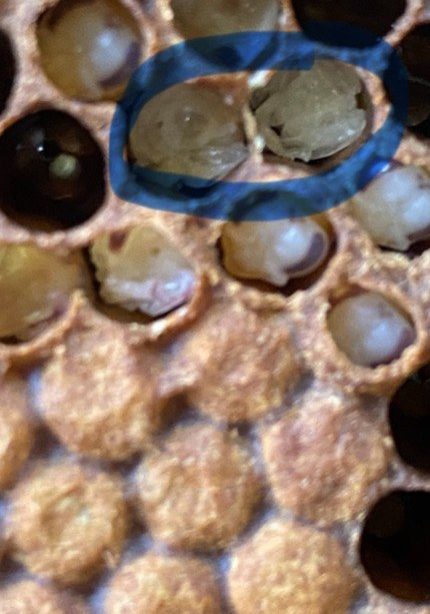
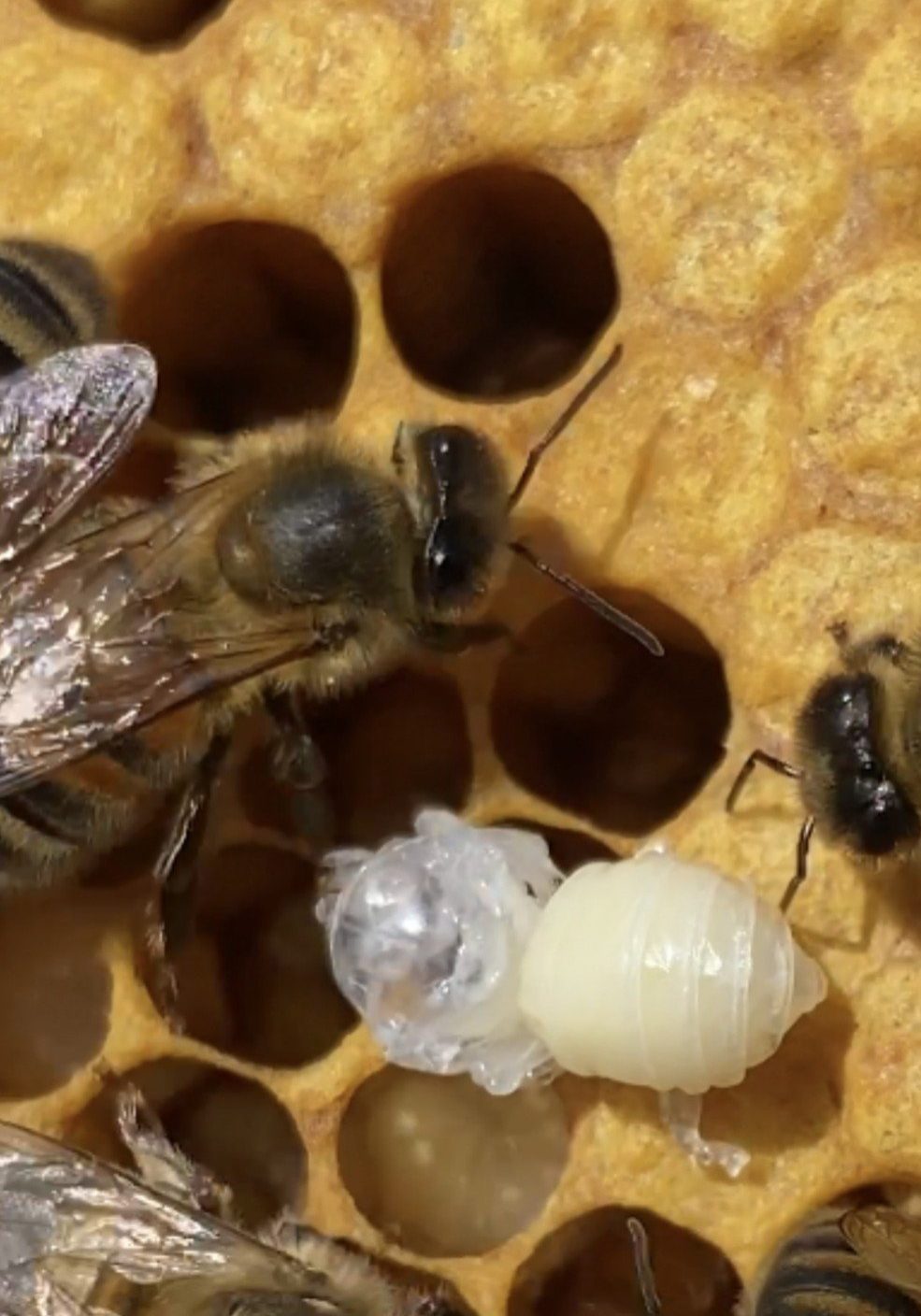
If you watched Live@theHive on October 4th, you’ll have seen Roger Patterson discover uncapped worker brood cells at the pink/purple eyed pupal stage in one of his colonies in his home apiary, one of the key traits of varroa resistant bees. Roger and I discussed observations of chewing out infected pupae, the other key trait. Occasionally, you do see evidence of chewing out on the frames (see pictures), but not always. Pupal exoskeletons on the insert board are a sure-fire way of knowing it is occurring.
We have created a separate video of Roger’s discovery and our discussion here: https://www.youtube.com/watch?v=ZgTLE21Eayk
Please do subscribe to our YouTube channel so you can get updates when we release new videos.
There was a follow-up question to the video asking whether Roger might breed from this queen to see if the daughters have the same traits. This is certainly a candidate for breeding from as it is showing the traits, but you’d want to stop varroa treatments and monitor the colony and any daughter colonies to confirm varroa resistance (uncapping, chewing out and a low mite count) over at least a whole season and longer.
In my own apiaries, I don’t add a queen line to my breeding lines until I have confirmed varroa resistance for three seasons. In the Westerham club bee breeding project, all our queen lines have been selected from lines that haven’t been treated for seven years or more. We are lucky enough to have colonies with a history of varroa resistance. If you are starting on your varroa resistant journey you would jump on any signs of the traits and select for them whilst monitoring and counting over several seasons.
In terms of heritability of traits, my experience is that every daughter I have raised from a varroa resistant queen line has so far gone on to head a colony that is also varroa resistant. All my queens are open mated. The role of the drones in heritability is an area needing more research, but I continue to try and flood the area with drones from varroa resistant colonies.
One of my winter jobs will be to review all the varroa resistance data for my colonies over the whole season and decide on my breeding plan for 2026. I’ll again be breeding from the very best performers, re-queening the ones with the highest mite counts, and monitoring the rest, including the ones I re-queened this year.
Next month I’ll talk about the colonies that had previously been treated and were showing high daily mite drops that I requeened. I wrote in previous articles that uncapping and chewing out had started as soon as the new queen’s offspring had become dominant, and as we head into the winter I am now reviewing the daily mite drop data.
Varroa resistant summary for October:
- Uncapping and chewing out is continuing as the ivy flow keeps queen laying
- Daily mite drop numbers have remained very low in my best performing colonies, while the spike in drop in other colonies is now ebbing.
- Insert boards come into their own now as you can continue to record mite drop numbers throughout the winter and pupal exoskeletons provide evidence of chewing out when there is brood present.
- Winter jobs include continuing to record your average daily mite drop and observations of pupal exoskeletons, and making your plan for proliferating your varroa resistant stock in 2026.
Every month through the season, we will publish an article detailing what’s going on in varroa resistant apiaries, explaining our observations, to help those who may be starting their varroa resistant journey. The first article was published in the February edition of BIBBA Monthly.
 Joe Ibbertson
Red Listed
Wild Western Honey Bees (Apis mellifera) are now classified as Endangered in much of Europe, including southeast England, according to the IUCN Red List of Threatened Species.
Free-living colonies face severe threats from habitat loss, pesticides, invasive species like Varroa mites and Asian hornets, and genetic impacts from modern beekeeping.
Key survival depends on natural nesting sites and diverse foraging habitats, including urban areas.
Conservation efforts highlighted by the Red List include:
- protecting habitats
- controlling invasive predators and parasites
- promoting native bee subspecies,
- avoiding non-native genotype introductions
- expanding research
Without action, Europe’s wild honey bees — vital pollinators — face further decline.
Join us at the National Honey Show (23rd-25th October)
Are you thinking about visiting the National Honey Show at Sandown Park Racecourse this coming week? The show runs from Thursday 23rd to Saturday 25th October 2025 and is the premier honey event in the UK beekeeping calendar.
As usual, we will be there hosting the BIBBA stand, hoping to talk about all things beekeeping. This year, in particular, has seen a big change in beekeepers' understanding of Varroa Resistance behaviour and how to move away from constant Varroa treatments towards keeping naturally untreated colonies. We know that leaving colonies completely untreated can lead to high losses for many UK beekeepers, but selective breeding for Varroa-resistant traits is a growing area of interest and success.
If you've got a question about Varroa Resistance, want to learn about different breeding programmes, or are just keen to chat about the latest in bee health, head over to the stand and we'd love to have a conversation.
The National Honey Show looks to have a fantastic line-up of speakers for you at its Lecture Convention, including two key speakers on our favourite topics! Dr. Humberto Boncristiani from the USA will be giving multiple talks, including a session on "How Pesticides Harm Bees and Their Keepers" and another on "Honey Bee Viruses," which addresses how these factors affect not only bees but us as well. You can also catch Steve Martin speaking on "Understanding Varroa resistance and moving away from mite control."
It's set to be a brilliant show, packed with exhibitors, workshops, and competitive classes. We hope to see you there!

Optimising a honey bee brood box for winter
Did you catch our latest video on YouTube?
The looming UK winter is a make-or-break period for your honey bee colonies. If you think pouring on the final syrup is all you need to do, BIBBA has released an essential video demonstrating one crucial step many beekeepers overlook: optimising the brood box layout.
In this practical, hands-on guide, Roger Patterson dives into a hive to show you exactly how to ensure your bees are perfectly positioned for survival. He highlights a major winter risk: a colony cluster can easily starve if the brood nest is pushed to one side of the box—even if there’s a full frame of honey just a few inches away!
The solution is centralisation!
Roger walks you through inspecting a colony, confirming its queen status, and then strategically moving heavy food frames to hug the brood nest from both sides, creating an optimal winter survival block.
Watch the full video to see the inspection process and gain the confidence to make this small, but colony-saving, adjustment to your own hives before the weather turns too cold.
Watch the full video now! Video: Optimising a honey bee brood box before winter Channel: Bee Improvement and Bee Breeders Association BIBBA http://www.youtube.com/watch?v=EzPsC9N1FGk

BIBBA Supports the BAN on Imports
of Honey Bees, Queens, Semen, Eggs and Used Equipment into the UK
As well as the previously listed reasons in the 2021 statement, the more critical and urgent BIBBA position on the banning of imports is justified by:
-
Tropilaelaps threat.
This species is now established in Europe (as well as further afield) and, if it came to the UK shores, is almost certain to quickly devastate the UK bee stocks, both managed and free-living. -
Small Hive Beetle (SHB) threat.
This species is also established within Europe (as well as further afield) and is known to also have a destructive effect on bee colonies and honey production.

Why BIBBA Opposes Imports
Locally adapted honey bees have long been known by experienced beekeepers to consistently perform better than exotic imports
Here are fifteen reasons why BIBBA opposes the importation of honey bees and queens