December: Ending the year where we started it, or better
Here in the southeast of England, we’ve had a wet start to winter, but also a very mild one. There have been a few frosts, but in the second week of December I visited a couple of apiaries to do winter checks and I was left in no doubt that all the colonies were still alive because they were all flying in about 14 degrees Celsius. They’re all still hefting heavy, so I’m also not worried about stores as yet.
If you’re new to hefting, then Roger Patterson describes how he does it on a recent video we have added to the BIBBA YouTube channel. Please do subscribe to the channel as we’ll be adding new videos throughout the winter so you can take some new tips and tricks into the new season.
We have already added a number of videos on the impending threat of Tropilaelaps, which brings with it fate worse than varroa. In videos part funded by BIBBA, the team at PHIRA Science explain the lifecycle and symptoms of the mite and how to spot them in your colonies, while Roger Patterson caught up with a bee farmer in Georgia who told him how the spread of the mite is hammering commercial and hobbyist beekeeping in the country.
It’s just one reason why BIBBA supports a ban on bee and queen imports into the UK. You can find out all the reasons why BIBBA supports a ban here, including the potential adverse impact on the work being done to raise local varroa resistant bees.
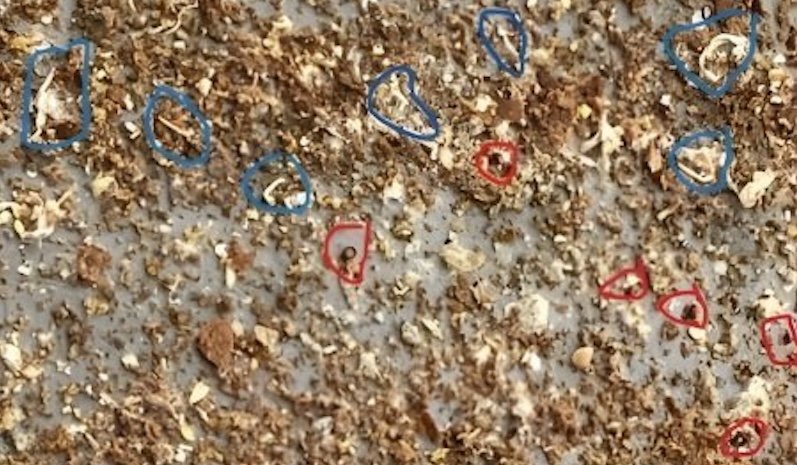
In my varroa resistant apiaries, my winter checks at the hive start with varroa. I take out the insert board or tray and inspect it and take a photo of each one for a more detailed analysis and mite count when I get home and can blow it up on my phone and record the results in the warm. (The bottom boards also confirmed my flying bees weren't robbing each other).
After cleaning the board or tray off, I will then heft, and where I have a see-through crown board I might be tempted to peek under the insulation if it’s not too cold. In some colonies you can see the cluster pancaked across the Perspex crown board, while in others the cluster remains down in the brood chamber. I check entrances to make sure they’re clear, and occasionally you’ll see evidence of varroa resistance here too, with pupal parts removed via the entrance after being chewed out of varroa infested worker brood cells.
 Steve McGrath
If you leave it too long between winter checks, then a build up of debris can make It difficult to do an effective mite count by sight alone, even when blown up on your phone or computer. In this case, I scrape the bottom board debris into a corner and then into a container – a sealable freezer or food bag works well. When home, I take the debris out and either sift through it (a pair of tweezers works well to move debris around and sort pieces) or soak it in methylated spirits In a container, give it a shake and let it settle. Most of the debris stays at the bottom, while the mites and some light debris floats, enabling a more accurate count.
 Steve McGrath
I’m looking for individual colonies to end December with a mite drop count no higher, and preferably lower, than where they started back in January. So far, this seems to be the case across my colonies.
I’m also busy pulling together the mite drop data for the whole year, and it’s looking very positive, with my best hives so far showing a daily average mite drop of fewer than one a day for the year as a whole. That will be my best year in terms of mite drop. This continual decline in mite drops over seasons in varroa resistant colonies has been observed by other varroa resistant beekeepers.
In any varroa resistant colony which is uncapping cells and chewing out infected pupae, I would like a maximum average daily drop of fewer than five for the whole year. Any higher than this and I will be looking to re-queen the colony next season.
The full data set will influence my breeding program for 2026, raising queens from the best third, re-queening the worst third and monitoring the third in the middle.
The data sets from the colonies that weren’t varroa resistant and were re-queened with a queen from a varroa resistant queen line will be very interesting and I will share a case study on them in BIBBA Monthly next year.
For anyone transitioning to varroa resistance, this can be a nervous time of year as the winter treatment could be the first one you skip as part of the transition. It’s advisable to make sure you have clearly seen signs of both uncapping and chewing out of infected pupae in the colony over the summer and that you’re monitoring mite drops. Remember, uncapping alone is not enough, you need to see evidence of chewing out. With your insert board in, you’ll be able to continue counting mite drops and record evidence of chewing out throughout the winter. Spring will better reveal how your bees are coping without that treatment.
Varroa resistant summary for December:
- Insert boards and trays are now the beekeeper’s essential tool for monitoring varroa resistance over winter. You’ll be able to do average daily mite drop counts throughout the cold period, while pupal parts will evidence chewing out during periods where there is brood.
- The aim is to end the year with a daily mite drop at least the same as, and preferably below, where the colony started the year.
- At the end of December, you can calculate the average daily mite drop for the year as a whole. A number of five or fewer, combined with evidence of uncapping of brood cells and chewing out of infected pupae recorded during the year, shows strong varroa resistance.
- Winter jobs include continuing to record your average daily mite drop and observations of pupal exoskeletons every time you go to check and heft hives. Try and do this regularly so that debris doesn’t build up too much. Otherwise you’ll have to sift the debris to do an effective mite drop count.
- If you’re transitioning to varroa resistance, the winter treatment could be the first one you skip. It’s advisable to make sure you’ve evidenced the key traits of varroa resistance – uncapping and chewing out of infected pupae – before you take that risk.